
By Zena Takieddine
We are sitting in stunned silence at the Metropolitan Cinema hall in Beirut, having just watched the award-winning and aptly-named short film Samt (Silence). And then, a thundering of applause as Lebanese animation artist, dancer and filmmaker Chadi Aoun is invited up to the stage. “Which came first,” asks art curator Rasha Salti, “the story, the drawing or the dancing?”
“Certainly the story,” Aoun answers. “The story is part of my life.” He speaks with a friendly and unassuming smile as if he did not just masterfully crush us all. This was the second screening of his film in Lebanon, but a first viewing for me. Samt premiered at the 2016 Lebanese Film Festival, where it won the best fictional film award. In this story of social oppression, Aoun holds us captive by the beauty, care and cruelty he delivers.
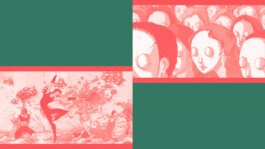
Samt was directed and produced by Aoun more-or-less single-handedly. A bit about his process, the film is entirely rendered in 2D animation, painstakingly sketched by hand on paper, then drawn and colored on a tablet in Photoshop. “I animated most of the scenes myself. At 12 frames per second for a 15-minute film, you can imagine how much work that takes,” he says. There is also a black and white sequence, animated in 24 frames per second, “for increased detail and fluidity of movement,” contrasting two different visual styles.
The name of the city we discover in the film is Ghabra – the City of Dust. The only sounds you hear are the rattle of con(dis)struction machines rumbling in the background and the hushed murmurs and shuffling feet of a subdued population. That’s it. We see citizens in grey move like anonymous herds, masked and wordless. They tread through policed streets, lining up in queues to purchase things. Posters and billboards dominate the city, featuring slogans of authority from the Silence Police and advertisements of consumer goods. The graffiti on the walls is an amalgam of cultural references from the Arab region so Ghabra feels eerily familiar to the audience. Aoun's embeds architectural elements and street art that place the story decidedly in an Arab city, merging flavors of Beirut, Jerusalem and Casablanca.
The lead character is a sloped-shoulder, lanky, depressed-looking guy who slinks around in the shadows, observing, meekly from the fringes of society. He has feline qualities, almond-shaped pupils and a proclivity for nocturnal walks and a barely-restrained sense of curiosity. From abandoned parking lots, alleyways, rooftops, basements, he is seeking out sound. But, in a city where the accidental jingle of hidden gold bracelets on a cloaked woman’s wrist can lead to a radical spectacle of her punishment, what can our muffled protagonist do?
Our unlikely hero is paired with a whimsical cat and one of the most memorable moments in the film is watching the cat stepping daintily on the railing of a wrought-iron stairway and reaching up with its paw to a string that tinkles a bell. In tightly-controlled Ghabra, the little furry animal tickles the possibility of disobedience, curiosity, freedom.
“The last thing that came into it was dance,” says Aoun “This will come as a surprise to people who know me, since they know that dance is absolutely essential to my life. At first I was just thinking about the sound of the film. No facial expressions. No movement. And then, it hit me. Dance would be a great way to make the story move.” Like most good ideas, it came to him in the shower.
And so the lead character comes across some unexpected company, fellow mischief-makers with far more audacity than he: dancers. The possibility of love sizzles across the screen. With this encounter, the lead character is transformed beyond anything he has known, yet fulfilling his deepest heart’s desire. “Love dares you to do new things,” says Aoun with a twinkle. The visual rendering of this transformation is simple and exhilarating. Gone is the cityscape with all its accumulated histories. In the ecstasy of dance, he runs free, leaping and soaring faster and faster through endlessly open space.
Coupling the visual rendition is the audio mastery. “So much happens in this film, without a single word being uttered,” says Aoun.
The music process took a bit of time, Aoun tells us. “I wanted a score and an ambience that would make me believe what I was seeing, after all these years of work.” The sound designer and music producer, Fadi Tabbal, worked in collaboration with Stephane Rives of Tunefork Studios. “Fadi Tabbal was a great guide in creating the aural experience. He gave a lot of subtlety to the movie,” Aoun says. Tabbal was also a player and composer alongside Maya Aghniadis, Oliver Maalouf, Pascal Semerdjian and Marwan Tohme.
Zena Takieddine – an art historian, editor, yoga teacher and somatic experiencing practitioner. She is active in the non-profit social sector, working with vulnerable communities through creative body-mind practices that stimulate well-being and resilience.